


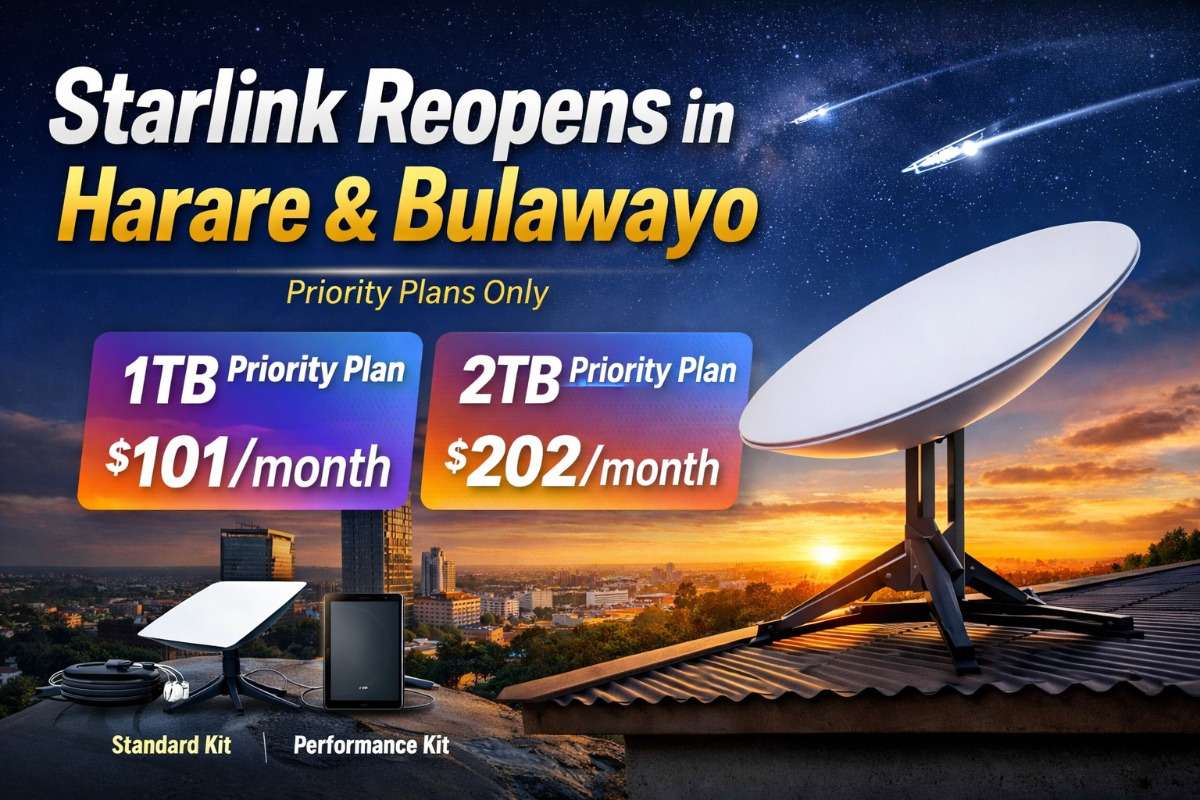
After months of waiting, Starlink has quietly reopened orders in Harare and Bulawayo, two of Zimbabwe’s most in-demand areas for starlink internet. For many residents and businesses, this comes as welcome news after long periods of “sold out” notices on the company’s website. However, the reopening comes with an important condition. For now, only Priority, also known as Business plans are available. Residential packages, which most home users have been waiting for, remain unavailable in these high-demand areas.
As of today, customers in Harare and Bulawayo can only subscribe to Starlink’s Priority data packages. The available options are a 1TB Priority plan priced at US$101 per month and a 2TB Priority plan priced at US$202 per month. These plans are designed mainly for businesses, media houses, developers, online traders, and organisations that rely heavily on stable internet. They come with higher network priority, faster speeds, and more consistent performance, especially during peak hours. For many Zimbabwean companies struggling with slow and unstable connections this presents a strong alternative.
In addition to the monthly subscription, customers are also required to purchase Starlink hardware. There are currently two options available. The Standard Kit, which costs US$389, is suitable for small offices, home-based businesses, freelancers, and startups. It is enough for most everyday business needs. The Performance Kit, priced at US$1,499, is designed for larger organisations, high-traffic offices, and harsh environments. While it offers stronger performance, its high cost places it beyond the reach of many small operators.
How to Order Starlink Business Plans in Zimbabwe (Step by Step)
Step 1: Visit the Order Page
Go to starlink and click on “Get Started.”
Step 2: Enter Your Service Address
Type in the address where you will use the Starlink device. This helps the system confirm availability in your area. After entering the address, click “Get Started” again.
Step 3: Choose Your Service Plan
Select either the 1TB Priority plan at US$101 per month or the 2TB Priority plan at US$202 per month, then continue.
Step 4: Select Your Hardware Kit
Choose between the Standard Kit (US$389) and the Performance Kit (US$1,499). After making your choice, proceed to checkout.
Step 5: Enter Your Personal and Business Details
Fill in your name, contact information, and business name if applicable. Make sure all details are correct before moving forward.
Step 6: Provide a Delivery Address
Enter the address where the equipment will be delivered. This address does not have to be the same as the service address. It can be your home, office, or a courier location.
Step 7: Make Payment and Place Your Order
Enter your card details and complete the payment process. Users report that EcoCash Mastercard and Omari Mastercard are currently working. Once payment is successful, your order will be confirmed and processed for delivery.
This partial reopening highlights just how strong the demand for Starlink remains in Zimbabwe’s major cities. While businesses now have an opportunity to access reliable satellite internet, ordinary home users are still locked out of residential plans. At the same time, the high cost of both the subscription and hardware means that many people will continue to find the service difficult to afford. Despite this, for companies that depend on constant connectivity, such as digital agencies, software developers, journalists, call centres, and online shops, Starlink could significantly improve productivity.
So far, Starlink has not announced when residential packages will return to Harare and Bulawayo. In the past, availability has improved when more satellites were launched and network capacity increased. Until then, home users will need to remain patient and keep checking the website for updates.
For now, the message is clear. Starlink is back in Harare and Bulawayo, but only for Priority customers. Those who can afford the business plans and equipment have a chance to secure fast and stable internet, while everyone else will have to wait a little longer for residential access to reopen.





Please login or create account to comment.