


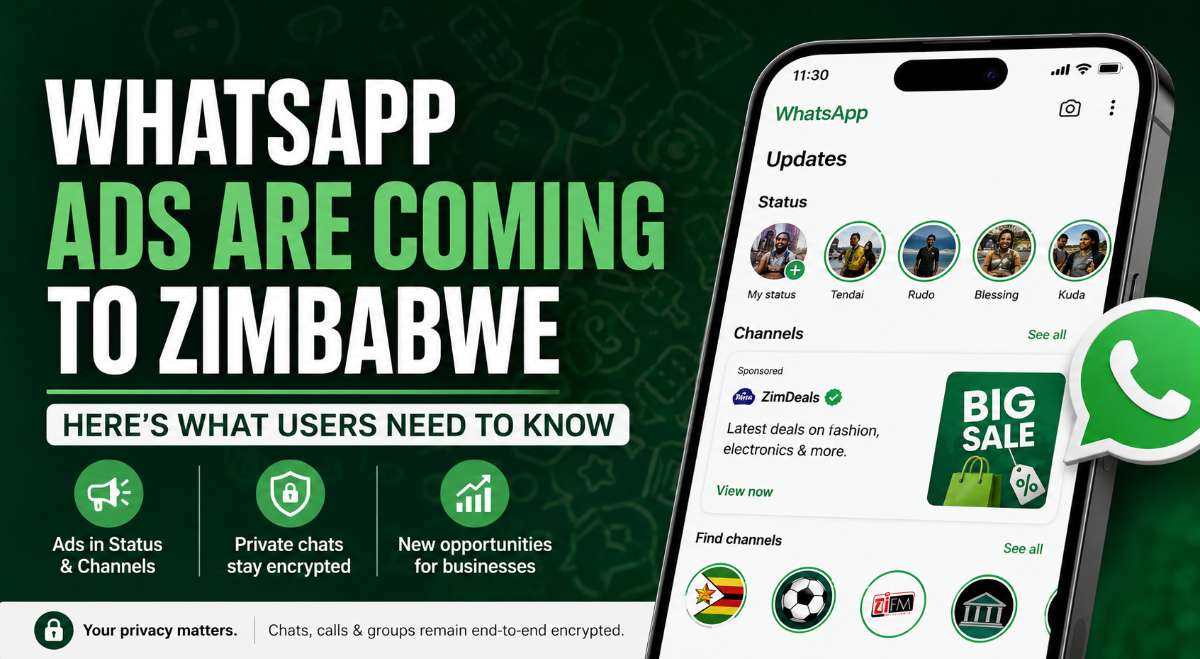
Many Zimbabweans woke up this week to a surprising WhatsApp notification: ads are coming to the app.
For a platform that built its reputation around simple, private messaging, the announcement immediately raised questions. Will chats now contain adverts? Is Meta reading messages? And what does this mean for Zimbabwean users who already spend heavily on mobile data?
In Zimbabwe, where WhatsApp is practically essential infrastructure for communication, business and news sharing, the move could affect millions of users.
The company says users will soon begin seeing “relevant ads” inside Status and Channels. However, WhatsApp insists personal chats, calls and group messages will remain private and end-to-end encrypted.
So where exactly will the ads appear?
The adverts will appear inside the “Updates” tab, specifically in WhatsApp Status and Channels.
If you regularly scroll through Status updates from friends and family, you will now begin seeing sponsored posts in between them, similar to how Instagram Stories ads work. Users will still be able to swipe past them normally.
WhatsApp is also introducing “Promoted Channels,” allowing businesses, creators and organisations to pay for more visibility inside the Channels section.
In short, WhatsApp is no longer just a messaging app. It is steadily becoming a business and content discovery platform.
Why Meta is introducing ads
The reason is simple: WhatsApp needs to make money.
Despite having over 2 billion users worldwide, WhatsApp has never generated advertising revenue on the same scale as Facebook or Instagram. For years, Meta has looked for ways to monetise the platform without disrupting private conversations.
Advertising was always likely to arrive eventually.
The company says the Updates tab is now used daily by around 1.5 billion people globally, making it one of the most valuable spaces on the internet for advertisers.
At the same time, Meta knows WhatsApp’s reputation is built on privacy. Placing adverts directly inside chats would almost certainly trigger backlash from users.
That is why the company keeps stressing that private messages and calls are not being used for advertising.
What data will WhatsApp use for ads?
This is where things become more nuanced.
WhatsApp says it will not use the content of your messages, calls or groups for ad targeting because those remain encrypted.
However, Meta may still use surrounding account information such as:
- Your language
- Your country or city
- Channels you follow
- Ads you interact with
- General activity across Meta platforms
So while your messages themselves remain private, Meta can still personalise adverts using broader user behaviour.
For many Zimbabweans, the word “encrypted” often sounds like complete privacy. But in reality, there is a difference between protecting message content and tracking user activity around the platform.
What this means for Zimbabweans
For many users, the change may initially feel small. Most people already spend hours viewing Status updates daily, so seeing occasional adverts could quickly become normal.
But the long-term implications are bigger.
Zimbabwean businesses may benefit
Small businesses in Zimbabwe already rely heavily on WhatsApp.
From boutiques and restaurants to transport operators and hardware shops, thousands of informal businesses operate almost entirely through WhatsApp Status updates and groups.
The arrival of Status advertising could create a new marketing tool for local businesses trying to reach customers without spending heavily on traditional advertising platforms.
WhatsApp may become more commercial
Zimbabweans use WhatsApp differently from many other countries. For many people, it is more important than email.
It is where people communicate with customers, receive church announcements, buy products, follow news updates and stay connected with family.
As adverts become more common, the platform may slowly feel less like a private messaging space and more like a commercial social network.
Some users will accept that shift easily. Others may not.
Mobile data costs could quietly rise
This is one concern many Zimbabweans will immediately understand.
Sponsored videos and image adverts inside Status may consume additional mobile data, especially for users relying on smaller daily or weekly bundles. While individual ads may seem insignificant, they can add up over time.
In a country where internet access remains expensive for many people, even small increases in data usage matter.
Can users disable the ads?
At the moment, WhatsApp has not introduced a full option to disable adverts completely.
Users may be able to hide certain advertisers or influence the types of ads they see, but advertising itself now appears to be part of WhatsApp’s future direction.
That means ads on WhatsApp are likely here to stay.
The bigger picture
WhatsApp entering the advertising business marks the end of an era.
For years, the platform stood apart from Facebook and Instagram because it felt cleaner, simpler and less commercialised. But as Meta pushes deeper into business tools, AI features and monetisation, WhatsApp is slowly becoming another platform inside the broader Meta ecosystem.
The company understands that trust is WhatsApp’s greatest asset. That is why it continues emphasising privacy protections while carefully introducing advertising in limited sections of the app.
For Zimbabwean users, the real question now is no longer whether ads are coming.
It is how much of the WhatsApp experience will eventually change alongside them.





Commenting is currently turned off.