


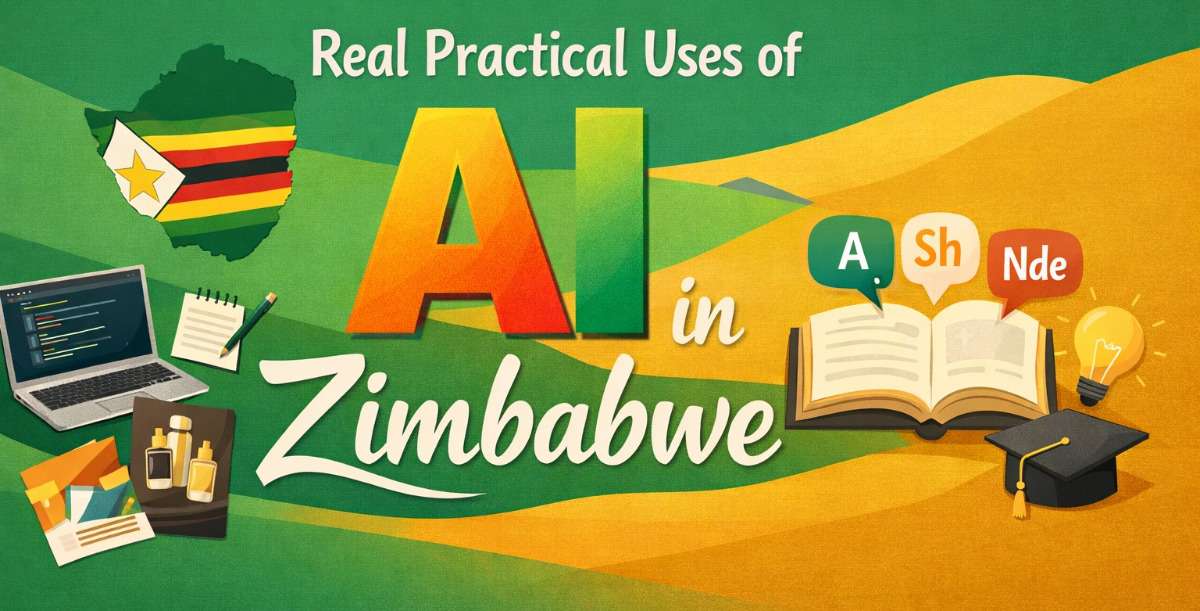
Artificial intelligence (AI) often sounds like something distant, a technology built for Silicon Valley, not for everyday life in Zimbabwe. But that picture is slowly changing. Across the country, people are beginning to use AI in simple, practical ways that make a real difference in how they work, learn, and run their businesses. This article is a summary of some of the most practical uses already taking shape locally. In the coming weeks, we will publish a series of in-depth articles exploring each of these areas in detail, focusing on real tools, real examples, and how Zimbabweans can start using them.
Designing Flyers Without a Designer
For many small businesses in Zimbabwe, marketing has always been a challenge. Hiring a designer costs money, and learning design software takes time that most entrepreneurs simply don’t have. AI is starting to change that. Today, a small business owner can describe the kind of flyer they want whether it’s a perfume promotion, a salon special, or a weekend sale and get a clean, professional design within minutes.
This makes it easier to respond quickly to opportunities. A shop owner in Harare or a vendor in Bulawayo no longer has to wait days for a design or settle for something basic. Instead, they can create something that looks polished and appealing, helping them compete more effectively in a crowded market.
Writing Help for Everyday Content
Writing is another area where AI is proving useful in very practical ways. Many people have ideas but struggle to put them into clear, structured words. AI helps bridge that gap. It can turn rough thoughts into full articles, improve grammar, and simplify language so that messages are easier to understand.
For students, this can mean better assignments and clearer expression. For business owners, it can mean more consistent and professional posts on platforms like WhatsApp and Facebook. And for content creators, it allows for faster production without losing quality. The result is not perfect writing, but more confident communication.
Building Applications Faster
For developers, AI is becoming something like a quiet partner in the background. It assists with writing code, fixing errors, and explaining unfamiliar concepts. This is especially valuable in Zimbabwe, where many developers work independently without large teams or easy access to mentorship.
Instead of spending hours searching for solutions, a developer can get immediate guidance and move forward. Whether someone is building a news platform, an e-commerce site, or a local service app, AI reduces friction in the development process. It doesn’t replace skill, but it speeds up learning and execution in a meaningful way.
Learning With Simple, Clear Explanations
Education is one of the areas where AI’s impact feels the most personal. Understanding a concept is often harder than accessing it, and many students struggle with explanations that feel too complex or disconnected from their reality. AI can adjust to the learner’s level, breaking down topics into simple, step-by-step explanations.
A student can ask for complex topic to be explained as if they are in grade 5, or request examples that relate to everyday Zimbabwean life. This kind of flexibility makes learning less intimidating and more interactive. It also supports people who are learning outside formal classrooms, whether they are picking up new skills or revisiting subjects they once found difficult.
Bridging Language Gaps Through Translation
Zimbabwe’s multilingual nature is a strength, but it can also create communication challenges. AI-powered translation tools are beginning to help bridge those gaps by making it easier to move between English, Shona, and Ndebele.
This is useful in many everyday situations, from writing formal documents to understanding educational material or communicating in business settings. While translation tools are not yet perfect, they are already good enough to improve clarity and reduce misunderstandings, especially when used carefully.
A Quiet Shift With Real Impact
What ties all these use cases together is how practical they are. AI in Zimbabwe is not about dramatic change or futuristic ideas. It is about helping people do everyday tasks more efficiently. It allows individuals to design, write, build, and learn with fewer barriers.
This matters in a context where resources can be limited and time is always valuable. Instead of replacing people, AI is giving them more capacity to act, create, and grow.
This article has only scratched the surface. In the coming weeks, we will dive deeper into each of these areas, exploring specific tools, real-life use cases, and practical steps Zimbabweans can take to start using AI in their own work and daily lives.





Please login or create account to comment.